First Biru Fund Investment Revitalizes Hatchery and Supports Blue Economy in Berau
YKAN supports the Biru Fund initiative in Berau through hatchery revitalization and innovative financing under Koralestari and GFCR.
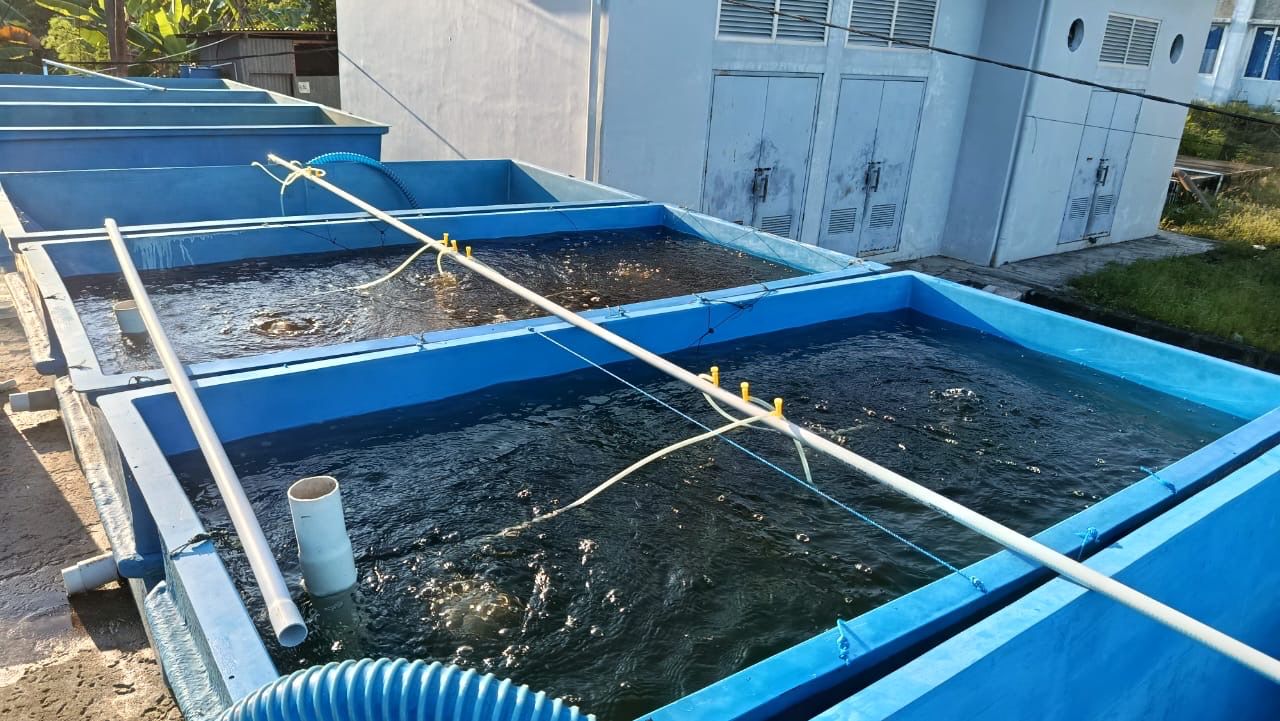
The first investment under the Biru Fund initiative, launched by Yayasan Konservasi Alam Nusantara (YKAN), has begun implementation through the revitalization of a tiger prawn hatchery at State Vocational High School (SMKN) 3 Tanjung Batu in Berau Regency, East Kalimantan. The program aims to strengthen shrimp farmers’ access to high-quality seed stock while promoting more sustainable aquaculture practices in coastal communities.
The initiative addresses one of the most persistent constraints in Berau’s aquaculture sector: limited access to reliable shrimp fry (benur). Farmers have traditionally depended on external supply hubs such as Surabaya and Tarakan. This reliance has often resulted in inconsistent availability and variable quality, compounded by high mortality rates during long-distance transport. By establishing a local hatchery, farmers can now access seed stock that is not only more reliable in quantity but also better preserved in quality, enabling more accurate production planning and improved farm efficiency.
Beyond production improvements, the program introduces an inclusive financing mechanism designed to reduce barriers for smallholder aquaculture producers. Through the Biru Fund, farmers can access zero-interest financing with a grace period of up to 10 months. Repayment is structured as a percentage of profits rather than fixed installments, allowing repayment obligations to align with harvest outcomes and reducing financial pressure at the start of production cycles. This model is intended to improve capital accessibility while minimizing the risk of over-indebtedness in volatile aquaculture markets.
Head of the Berau Fisheries Office, Abdul Majid, described the revitalization of the SMKN 3 hatchery as a strong example of collaboration between government, private sector actors, and non-governmental organizations. He emphasized that the initiative represents a practical innovation in addressing long-standing challenges in the supply of high-quality shrimp seed and in advancing brackish-water aquaculture technology.
“This is an innovative and creative effort by the government and partners to respond to the fundamental needs of shrimp farmers who have long struggled to obtain quality tiger prawn seed in Berau,” he said. He added that the program aligns with the regional government’s vision to improve community welfare, particularly within the fisheries sector, while acknowledging the continued support of the provincial government in strengthening public service delivery.
Majid further expressed hope that development partners such as YKAN would continue to inspire scalable and sustainable business innovations that benefit coastal livelihoods.
From an educational perspective, the program also integrates vocational training with industry practice. Catur Sketsa Suroso, teacher of brackish and marine aquaculture at SMKN 3 Tanjung Batu, emphasized that the hatchery serves not only as a production unit but also as a practical learning platform for students.
“This hatchery is not only a production facility but also a hands-on training site where students gain skills aligned with industry needs. We also work closely with private sector partners to ensure operational standards and learning modules are properly developed,” he explained.
The hatchery is further developed as a teaching factory model, allowing students to participate directly in shrimp seed production processes, from technical operations to basic business management. This experiential learning approach is designed to strengthen graduates’ readiness for employment or entrepreneurship in the aquaculture sector.
Operational management of the hatchery is carried out in partnership with private sector technical experts, notably PT Tri Karta Pratama (PT TKP), which oversees production management and contributes to the development of practical curricula for students.
For local farmers, the presence of a nearby hatchery significantly reduces production risks. Jumardi, a shrimp farmer from Suaran Village in Berau, noted that transportation distance has long been a critical factor affecting seed survival rates.
“Previously, benur often arrived in inconsistent quantities or suffered losses due to long transport distances. Now we can access shrimp fry more reliably and conveniently. The shorter distance reduces mortality rates and provides greater certainty for our farming operations,” he said.
The Biru Fund is part of the broader Koralestari initiative supported by the Global Fund for Coral Reefs (GFCR). It promotes a blue economy approach that integrates community welfare improvement with the protection of coastal ecosystems. Under this framework, aquaculture development is designed not only to increase production but also to ensure environmental sustainability.
YKAN supports the implementation of Biru Fund as an innovative financing instrument that encourages environmentally responsible practices in the fisheries sector. This includes capacity building, technical assistance, and the development of business models aligned with conservation principles.
“Through the Biru Fund, we aim to foster business models that are not only economically viable but also contribute to the protection of mangrove forests and coral reef ecosystems. This is an important step in ensuring the long-term sustainability of the fisheries sector in Berau,” said Muhammad Ilman, YKAN Ocean Program Director.
Looking ahead, this partnership based and innovation driven financing model is expected to be replicated in other coastal regions facing similar challenges. By integrating financial support, capacity building, and conservation linked incentives, the initiative aims to strengthen community resilience while safeguarding marine ecosystems over the long term.