
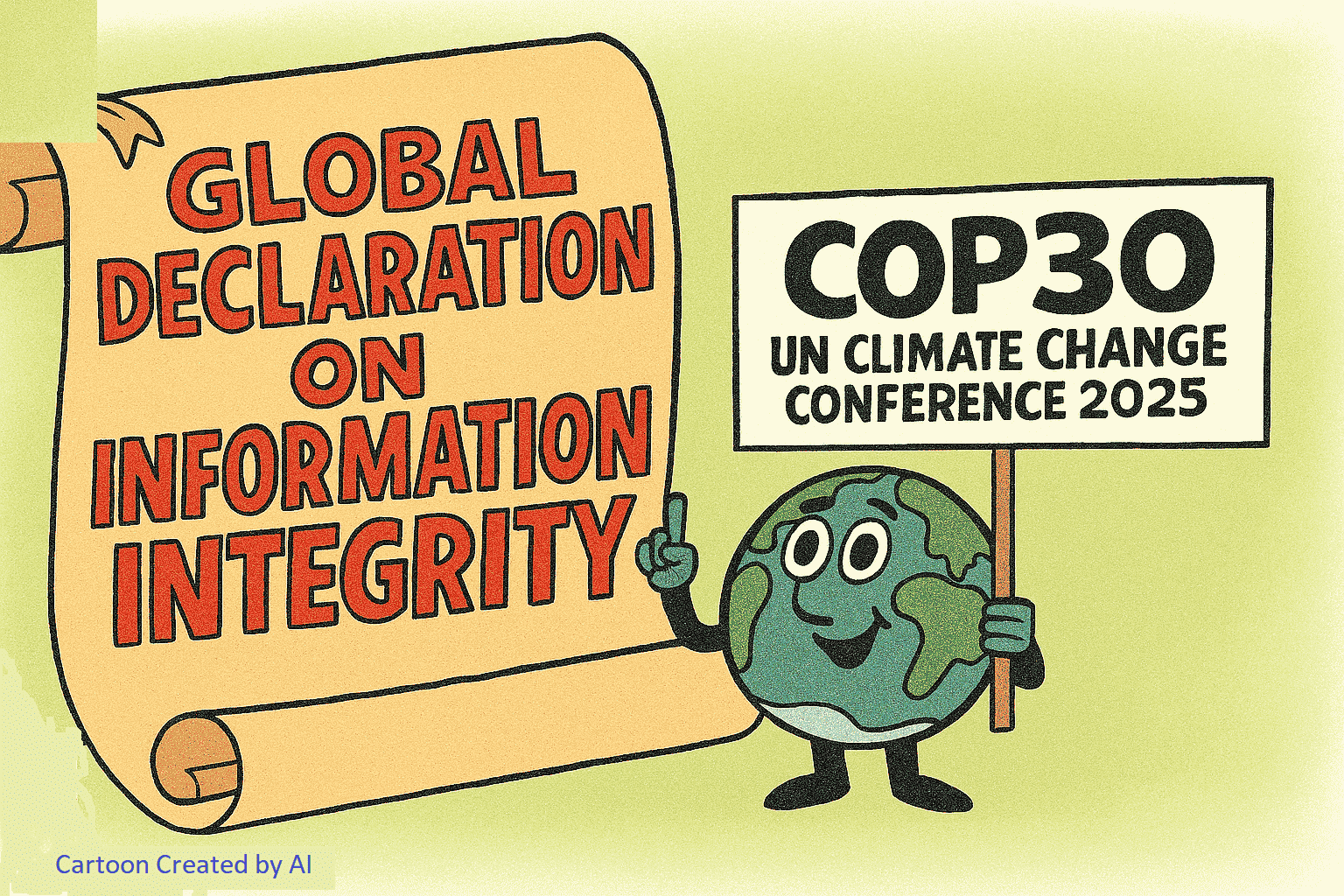
Global Declaration on Information Integrity on Climate Change: Implications for Donors, Recipients and Support Facilities and Organizations
Global Declaration on Information Integrity on Climate Change
Implications for Donors, Recipients and Support Facilities and Organizations
1. Introduction to the Declaration of Information Integrity on Climate Change
Marking the tenth anniversary of the Paris Agreement, COP30 formally adopted the Global Initiative for Information Integrity on Climate Change. This landmark Initiative represents a decisive collective effort to confront the spread of misinformation and disinformation that undermines effective climate action. By establishing higher standards of accountability in communication and reporting, it signals a profound recognition that the integrity of information is now a core global climate responsibility standing alongside emissions reduction and climate finance as pillars of the international action.
In its founding justifications, the declaration recognizes that the urgency of the climate crisis demands not only decisive action by States, but also by the broad engagement of all society segments including citizens, communities, businesses, subnational governments, civil society organizations, media, international organizations, universities, and research centers. The declaration further acknowledges that enabling the wide-scale mobilization of all these actors requires access to consistent, reliable, accurate and evidence-based information on climate change, enabling accountability, and building public trust. The document thus calls on all types of actors to take concrete measures to confront the growing impact of misinformation, false information, denialism, and deliberate attacks against information integrity checkers, journalists, advocates, scientists, and researchers, actions that undermine climate efforts and jeopardize societal empowerment.
2. Significance for Donor Countries
To date, the Declaration has been endorsed by twelve nations, primarily donor states from the Americas and Europe. These signatories have committed to safeguarding journalists and fact-checkers, a critical measure that strengthens the global capacity to expose greenwashing and challenge misleading project reporting on their own lands and in recipient countries. In doing so, they ensure that climate finance is transparently documented and translated into measurable outcomes and tangible impacts. Looking ahead, and considering the growing global financial pressures and uncertainty, it is quite likely that ongoing climate negotiations will embed the Declaration within independent monitoring and verification mechanisms, and place it as anchor criteria for managing their donations, further consolidating its role as a cornerstone of Global Climate Accountability.
3. Significance for Recipient Countries
For recipient states, joining the Declaration offers a powerful opportunity to build greater public confidence and international trust in their climate governance. Recipient countries may use the declaration as a strong tool to supporting international organizations like UN Agencies, and International NGOs working on their territories to adhere to its requirements. Recipient countries play a goalkeeping role by endorsing and channeling climate and biodiversity funds “GCF, GEF, GFCR, … etc.” into their national systems. To align with the Declaration they may emphasize upon endorsing and apply rigorous monitoring on fund managed by national and international organizations to ensure that funds entering their countries are transparently managed, accurately reported, and independently verified. Strengthening endorsement and monitoring procedures may include:
i. Making endorsement conditional on clear reporting commitments from implementing and executing agencies, and separating between the two giving increasing roles in execution to national agencies
ii. Requiring the implementing and executing agencies to follow robust open to public independent monitoring and verification. Thus including clauses that protect fact checkers, journalists and civil society monitors in project execution agreements
iii. Emphasizing the two tiered fund management, where the international agencies have only the role of implementers or fund conveyers while execution is entrusted to national agencies which are accountable in front of the national legal instruments. Following the tiered fund management doubles the fund management and reported results integrity as the executing national agencies become also accountable in front of the implementing International Organizations
iv. Maintaining a public national registry of all climate and biodiversity funds entering the country and linking registries to donor platforms “GCF, GEF, GFCR, ...” for accountability and consistency
v. Establishing publically accessible dashboards for timely publishing of projects’ progress details, budgets, and outcomes. Thus demonstrating how funds are translated into measurable outcomes and tangible impacts felt by the target communities
vi. Supporting local universities, NGOs, and media to act as independent watcheyes and provide the necessary training and resources for fact checking and data verification.
vii. Supporting collaboration between national audit offices, international organizations accountability standards and independent evaluators.
4. Significance for Global Funding Facilities Like GCF, GEF and GFCR
For global funding managing facilities like the Green Climate Fund “GCF”, the Global Environment Facility “GEF” and the Global Fund for Coral Reefs “GFCR” the declaration is highly significant. It strengthens accountability in climate finance. By prioritizing accurate, transparent, and evidence-based information, the Declaration directly supports these agencies’ mandates to ensure that funds are used effectively, projects deliver measurable impactful outcomes, and greenwashing or misleading reporting is prevented. This enhances the effectiveness of their funding, protects against reputational risks, and aligns their operations with the evolving standards of international climate governance. Practically, this may translate into the following results:
i. Strengthening Climate Finance Integrity
o- GCF, GEF and GFCR manage large-scale international funding streams for biodiversity and climate resilience in terrestrial and marine ecosystems. The Declaration elevates information integrity to the same level of importance as emissions reduction and finance, ensuring that project reporting is credible and verifiable
o- It safeguards against misreporting or inflated claims, which can undermine trust in climate finance.
ii. Protecting Monitoring and Evaluation Systems
o- GCF, GEF and GFCR rely on independent monitoring and evaluation frameworks to track project impacts, which could be further supported by having the Declaration embedded. A practical step here could be that these facilities embed in assignments of external audits implemented by the implementing /conveying agencies clauses on observing the Declaration during their work
o- The Declaration’s emphasis on protecting journalists, fact checkers, and independent monitors strengthens the ecosystem of accountability around funded projects. This ensures that the fund recipients cannot bypass safeguards or dilute reporting standards
iii. Enhancing Donor Confidence and Supporting Recipient Countries
o- Donor states, many of which endorsed the Declaration, expect transparency in how funds are used. By embedding information integrity into climate governance, GCF, GEF and GFCR can demonstrate that their portfolios are resilient against misinformation and greenwashing, reinforcing donor confidence.
o- Embedding the Declaration in the selection process. This supports countries receiving GCF, GEF or GFCR funding, accession to the Declaration offering greater credibility in climate governance
o- Transparent reporting aligned with the Declaration builds public trust in climate finance, which is critical for scaling up investments. It can attract more funding and partnerships that support the co-financing or blended financing required by these facilities
5. Significance for International Organizations
The Global Declaration on Information Integrity on Climate Change carries particular significance for international organizations whose legitimacy rests more on their global mandate and inherited institutional weight like UN Agencies, and International NGOs. As these organizations often derive trust from their global stature and the UN Agencies are exempt of the scrutiny of national legal instruments, the Declaration elevates information integrity as a core climate responsibility, meaning they must demonstrate that their local mandate is backed by transparent, accurate, and verifiable reporting. This helps prevent reputational risks where local stakeholders might otherwise question whether “global weight” is masking local accountability. This supports these agencies in several critical aspects, such as:
i. Countering Greenwashing and Misreporting
o- Large international agencies working in the Least Developed and Developing Countries are frequently, but due to the local conditions, quietly doubted of greenwashing or overstating impacts. By aligning with the Declaration, they commit to protecting and collaborating with fact checkers and independent monitors making it harder to bypass scrutiny
o- Strengthening confidence that their global influence is not being used to shield misleading project claims. It also reassures the public that inherited weight is matched by integrity in communication and reporting, which helps demonstrating that the global authority of these agencies is not detached from their local realities.
o- Donors and member states fund these agencies because of their global credibility. The Declaration provides a framework to show that funding translates into measurable, transparent and impactful outcomes, reinforcing donor confidence.
o- Bridging Global - Local Trust Gaps. In many recipient countries, local communities may distrust large international organizations due to limited visibility of impacts. The Declaration offers a mechanism to build local trust, by ensuring that reporting is accurate, and accessible.
o- Should the Declaration be integrated into monitoring and verification mechanisms in future climate negotiations, the inherited weight of global organizations will be increasingly judged on their ability to earn trust through transparent information practices to demonstrate that their global authority is not detached from the local realities.
ii. Practical Steps for Alignment
International organizations working mainly in the Least Developed and Developing Countries have a moral obligation of supporting these countries to move upwards in the Human Development Scale, i.e. least developed countries getting the status of developing countries and developing countries getting the status of developed countries. However, for several reasons it could be difficult for these countries to request this directly. The Declaration helps these organizations to stand for their responsibility seamlessly and realize this obligation by following simple practical steps that include:
o- Institutionalizing information integrity standards by adopting internal guidelines that reflect the Declaration’s principles: accuracy, transparency, and accountability in climate-related communications.
o- Integrating these standards into projects’ design, reporting, and evaluation, ensuring that all climate initiatives are grounded in verifiable data.
o- Protecting independent information actors by diligently following their Social and Environmental Standards and adding safeguards for fact checkers, journalists and civil society monitors who report on climate projects, especially in recipient countries.
o- Including clauses in the funding agreements that prohibit retaliation against independent scrutiny and promote open access to project data.
o- Strengthening monitoring and verification mechanisms. Although most projects have mid term and final evaluations administered by the implementing or conveying organization, additional third party and local community evaluations are needed
o- Enhancing the use of open data platforms to publish projects’ execution methodologies, raw data and results allowing public and peer review.
o- Countering disinformation proactively by developing rapid response protocols to identify and correct climate-related misinformation, especially around project’s results claims or use of funding.
o- Aligning funding criteria with integrity commitments by requiring grantees and executing partners to demonstrate compliance with information integrity standards, and prioritizing funding for projects that include community engagement, transparent reporting, and independent oversight.
o- Urging the recipient countries for capacity building in actual skills that enable national bodies to run projects. This can be achieved by the executing agencies delivering actual and sufficient training programs that strengthen the national foundations in managing climate and biodiversity projects
o- Finally yet importantly, separation of oversight and execution, adhering more strongly to the tiered funding modality rather than pursuing direct execution. This puts the pressure on the national foundations to run the funds effectively for the benefit of their countries and communities, enhances the projects’ funding and results oversight and supporting the Least Developed and Developing Countries to move upwards in the Huma Development Scale.
Related Knowledge Products
ECO-SI Coral Reefs 2020
- Article

No sizes attribute provided
GFCR Stakeholder Engagement Policy
- Policy

No sizes attribute provided