# Three-Day Technical Programme Showcases Scientific Cooperation under the Global Fund for Coral Reefs Project in Aqaba
# Three-Day Technical Programme Showcases Scientific Cooperation under the Global Fund for Coral Reefs Project in Aqaba
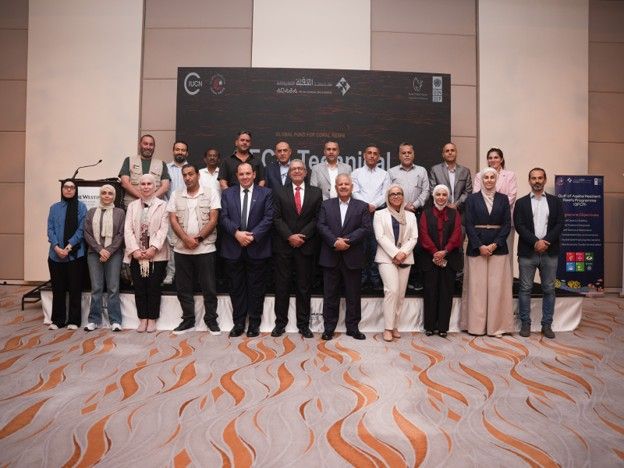
Hosted by the Aqaba Special Economic Zone Authority (ASEZA), a three-day technical programme concluded in Aqaba on 24 June 2026 to review and showcase the technical outputs of the collaboration between the United Nations Development Programme (UNDP) Jordan and the International Union for Conservation of Nature – Regional Office for West Asia (IUCN ROWA) under the Global Fund for Coral Reefs (GFCR) Project.
The programme was implemented under the cooperation agreement between UNDP Jordan and IUCN ROWA, through which IUCN served as an implementing partner responsible for delivering a range of specialized technical activities, including scientific studies, capacity development, and technical training to support the sustainable management of coral reef ecosystems in the Gulf of Aqaba.
The programme brought together representatives from government institutions, international organizations, academic institutions, local communities, and marine-related sectors, alongside national and regional marine experts. Activities included a specialized capacity-building training, a technical workshop to review the project's scientific outputs with partners and stakeholders, and a field visit to the Aqaba Marine Reserve and selected study sites, enabling participants to connect scientific findings with on-the-ground conservation and management practices.
The workshop highlighted key scientific outputs produced through the partnership, including the baseline assessment of the Gulf of Aqaba as a potential global climate refugium for coral reefs, ecosystem services valuation under projected climate scenarios to support sustainable financing and the Aqaba Marine Reserve Business Strategy, and the application of the Marine Integrated Model of Ecosystem Services (MIMES) to strengthen ecosystem-based management and science-informed decision-making. The technical sessions also provided an opportunity for participants to review the findings, exchange expertise, and provide feedback to strengthen the project's final deliverables.
The programme provided an important platform for knowledge exchange, technical dialogue, and stakeholder engagement, highlighting the value of science-based decision-making in strengthening coral reef conservation and sustainable marine management. It also reinforced the importance of strategic partnerships in supporting the long-term resilience of the Gulf of Aqaba's unique marine ecosystems and advancing collaborative environmental action across the region.