
GFCR eventWebinar
Financing to Maximise Employment in the Sustainable Ocean Economy
Event bringing together ocean finance experts to discuss promising approaches to maximise investment and employment in a sustainable ocean economy.
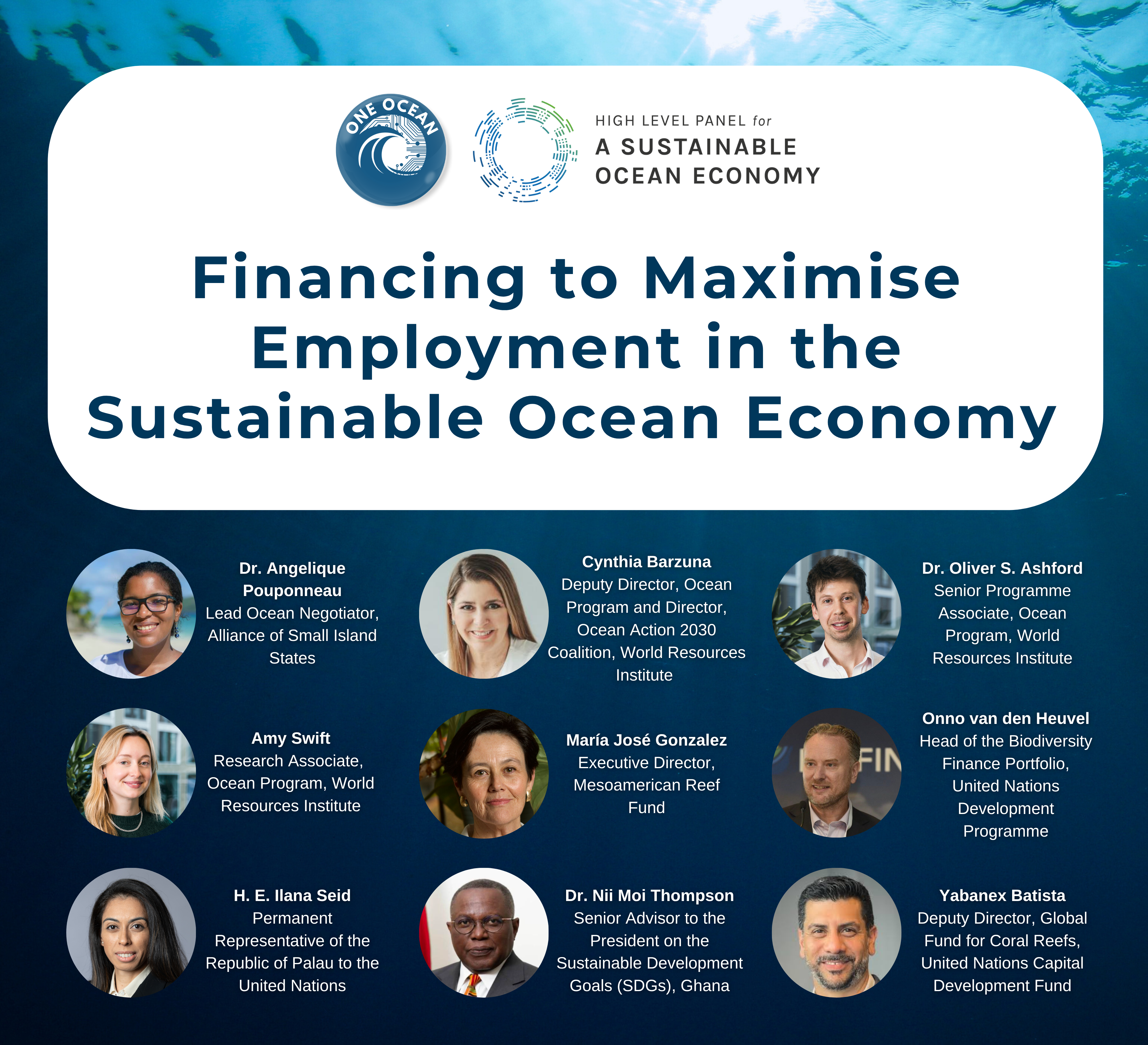
Financing to Maximise Employment in the Sustainable Ocean Economy brought together experts in ocean finance, policy, and practice to explore how investment can better support employment across sustainable ocean sectors. The webinar aimed to examine the scale of the employment opportunity in the sustainable ocean economy, the financing required to realise it, the barriers that currently limit progress, and the role that initiatives such as One Ocean Finance can play in unlocking more accessible, coordinated, and fit-for-purpose finance for people, nature, and climate.
Opening Presentations
Download PresentationsCynthia Barzuna, World Resources Institute
- Opened the session by introducing the Ocean Panel and its work to advance a sustainable ocean economy through science-based policy and international leadership.
- Framed the webinar around two linked questions: how employment in the ocean economy is changing, and how finance can help support a just and sustainable transition.
- Highlighted the relevance of the Ocean Panel’s recent papers on ocean employment and ocean finance as the foundation for the discussion.
Oliver S. Ashford, World Resources Institute
- Presented findings showing that the ocean economy already supports over 130 million jobs globally, with strong future growth potential if the transition to sustainability is managed well.
- Identified key sectors with high employment potential, particularly marine renewable energy, while noting likely declines in sectors such as offshore oil and gas.
- Emphasised that the transition will be shaped by major drivers including climate change, access to finance, policy choices, changing demand, and technology.
- Underlined that major challenges remain, including skills gaps, limited access to training, weak data, regional disparities, and risks of social inequity.
- Stressed the need for better workforce data, blue skills plans, more inclusive policies, formalisation of informal work, and innovative financing models to support a just transition.
Amy Swift, World Resources Institute
- Set out the current ocean finance landscape as fragmented, insufficient, and often misaligned with sustainable ocean economy goals.
- Highlighted the large financing gap, noting that current flows fall far short of the estimated US$550 billion per year needed to support the transition.
- Pointed to continued financing of harmful activities, including unsustainable fisheries support and fossil fuel subsidies, as a major obstacle.
- Emphasised the need to improve the enabling environment through stronger financial systems, clearer disclosure standards, better data, sustainable ocean taxonomies, and the removal of harmful subsidies.
- Stressed the importance of building pipelines of investable projects, strengthening ocean literacy, and improving equitable access to finance.
Yabanex Batista, Global Fund for Coral Reefs / One Ocean Finance Facility
- Framed the discussion around the need to connect finance, conservation, and jobs, arguing that sustainable ocean finance must also deliver benefits for the people and communities who depend on ocean ecosystems.
- Shared the GFCR’s experience in supporting reef-positive businesses and financial mechanisms that both reduce coral reef degradation and create local livelihood opportunities.
- Emphasised that blue jobs must not only be created, but should also build local capacity and strengthen the role of communities, local governments, and local enterprises in the transition.
- Introduced the One Ocean Finance Facility as a platform intended to help channel underused capital into ocean-positive sectors by reforming enabling conditions, crowding in finance, and building investable pathways.
- Throughout the panel, drew out the practical implications of the speakers’ remarks and reinforced the importance of focusing on inclusive, fair, and locally grounded employment outcomes.
Panel
Angelique Pouponneau
- Drew on the experience of Seychelles’ debt-for-nature swap and sovereign blue bond to show how innovative finance can support both ocean protection and employment pathways.
- Highlighted the importance of linking financing instruments to a clear national development vision, including thinking in advance about the human capacity needed to support the blue economy.
- Gave practical examples of how ocean finance can help create opportunities for young people and entrepreneurs, including in research, conservation, fisheries, creative industries, and sustainable materials.
- Identified key barriers to innovative ocean finance, including limited capacity, weak domestic private sector participation, and a tendency for local benefits to be overlooked if inclusion is not designed from the start.
- Stressed that success should not be measured by job numbers alone, but by job quality, including fair incomes, safety, social protection, and opportunities for personal development.
Nii Moi Thompson, Ghana
- Explained that Ghana’s Sustainable Ocean Plan places employment within a broader framework of decent work, rather than focusing only on job numbers.
- Emphasised that ocean employment should support higher living standards, with attention to productivity, incomes, and wider household wellbeing.
- Highlighted the importance of skills development, institution-building, and cross-sectoral coordination in supporting employment in the sustainable ocean economy.
- Noted that some sectors already provide significant employment, especially small-scale fisheries, but that the key issue is often improving the quality and formality of those jobs.
- Pointed to future opportunities in sectors such as ocean-based energy and marine pharmaceuticals, where there is strong untapped employment potential.
María José Gonzalez, MAR Fund
- Described the Mesoamerican Reef region as a space where the blue economy has traditionally centred on fishing and tourism, but where a wider range of reef-positive activities is now emerging.
- Highlighted growing potential for employment in areas such as sargassum upcycling, wastewater management, solid waste solutions, sustainable energy, aquaculture, mariculture, and blue carbon or nature credits.
- Identified major barriers faced by small-scale and community-based ventures, especially financial exclusion, weak access to affordable financial services, and limited financial literacy.
- Explained that for coastal small and medium enterprises, barriers include higher operating costs, climate impacts, permitting challenges, and the need for more tailored financing.
- Emphasised the need for the right type of funding for the right context, including blended finance, concessional funding, patient capital, de-risking tools, guarantees, and insurance products tailored to local realities.
- In the Q&A, added that MAR Fund is also exploring ways to combine insurance, guarantees, and tailored loans to address the climate and financial risks faced by small-scale fishers.
Onno van den Heuvel, UNDP
- Argued that creating sustainable ocean jobs requires identifying where current economic activity is harming the ocean and then redirecting investment toward nature-positive and ocean-positive alternatives.
- Emphasised that most ocean investments are ultimately investments in people and jobs, and that the goal is to find “win-win” opportunities for both livelihoods and ecosystems.
- Highlighted the importance of a seascape or ocean-space approach, linking sectors, places, and enabling conditions rather than treating investments in isolation.
- Stressed the role of governments in creating the right enabling environment through incentives, subsidy reform, regulation, and co-creation with finance initiatives such as One Ocean Finance
- In response to the Q&A, noted that nature-related and climate-related financial risks are increasingly recognised by financial institutions and central banks, but that more concrete action is still needed beyond diagnosis.
Closing Remarks
Ambassador Ilana Seid, Palau
- Closed by reinforcing that the sustainable ocean economy is fundamentally about people, livelihoods, and communities, not only technology or environmental targets.
- Highlighted that the ocean economy is already a major employer, and that a successful transition could grow employment significantly by 2050, while a failed transition could instead lead to job losses.
- Emphasised that finance sits at the centre of that transition and must be paired with investments in skills, workforce development, and strong national strategies.
- Pointed to the value of tools such as blue bonds, blended finance, tax incentives, and subsidy reform, while also stressing that no single mechanism will be enough on its own.
- Concluded that stronger coordination, collaboration, and innovation will be essential, and that One Ocean Finance can help translate finance into practical benefits such as quality jobs, livelihood transitions, and stronger local economies.
Author Global Fund for Coral Reefs
Start Apr 28, 2026
End Apr 28, 2026
Format Online
Time Zone BST
Host GFCR, One Ocean Finance, WRI, Ocean Panel